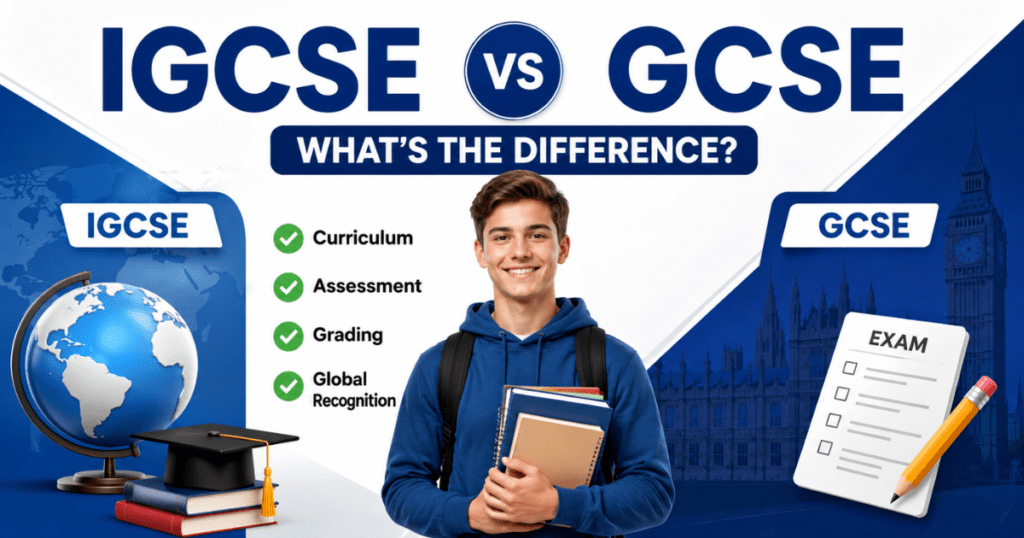
Many students and parents compare IGCSE and GCSE when choosing a secondary school qualification. Both qualifications are academically equivalent. There are important differences in curriculum, assessment, and international recognition. This article explains the IGCSE vs GCSE difference in simple terms.
What Is GCSE?
GCSE stands for General Certificate of Secondary Education. It is the standard qualification taken by students in England, Wales, and Northern Ireland at the end of secondary school, usually at age 16. GCSE courses are closely linked to the UK National Curriculum and are offered by exam boards such as AQA, OCR, Edexcel, and WJEC.
What Is IGCSE?
IGCSE stands for International General Certificate of Secondary Education. It was designed for students studying outside the UK and is offered in schools across more than 140 countries. Major providers include Cambridge International and Pearsonmel International. The curriculum has a more international focus and is widely accepted worldwide.
IGCSE vs GCSE Difference
Although both qualifications are considered equivalent, they differ in several areas.
| Feature | IGCSE | GCSE |
|---|---|---|
| Full Name | International General Certificate of Secondary Education | General Certificate of Secondary Education |
| Focus | International | UK-based |
| Availability | Worldwide | Mainly UK |
| Curriculum | Global perspective | UK National Curriculum |
| Assessment | Mostly exams | Exams and some coursework |
| Grading | A*-G or 9-1 | Mainly 9-1 |
| Exam Boards | Cambridge, Edexcel International | AQA, OCR, Edexcel, WJEC |
Is IGCSE Harder Than GCSE?
There is no simple answer. Both qualifications are designed to be academically equivalent. Some students find IGCSE subjects more challenging because they may contain additional topics or place greater emphasis on final examinations. Others find GCSE easier because it may include coursework in certain subjects. Difficulty often depends on the subject and exam board.
Do Universities Accept Both IGCSE and GCSE?
Yes. Universities, colleges, and employers generally recognize both qualifications as equivalent. Students with strong grades in either qualification can progress to A Levels, IB programmes, vocational courses, or university pathways.
Which Is Better: IGCSE or GCSE?
The best choice depends on the student’s goals.
- Choose IGCSE if you study in an international school or plan to move between countries.
- Choose GCSE if you follow the UK education system and study in a UK school.
- Both qualifications provide strong preparation for higher education.

FAQ’s
1. What is the main IGCSE vs GCSE difference?
The main difference is that IGCSE has an international focus and GCSE is designed mainly for students in the UK.
2. Is IGCSE accepted in the UK?
Yes. IGCSE qualifications are widely recognized by schools, colleges, universities, and employers in the UK.
3. Which qualification is better for international students?
IGCSE is often preferred for international students because it is designed for a global audience.
4. Do universities prefer IGCSE or GCSE?
No. Most universities consider IGCSE and GCSE equivalent qualifications.
5. Can students progress to A Levels after IGCSE or GCSE?
Yes. Both qualifications provide a pathway to A Levels, International A Levels, IB programmes, and other advanced studies.